
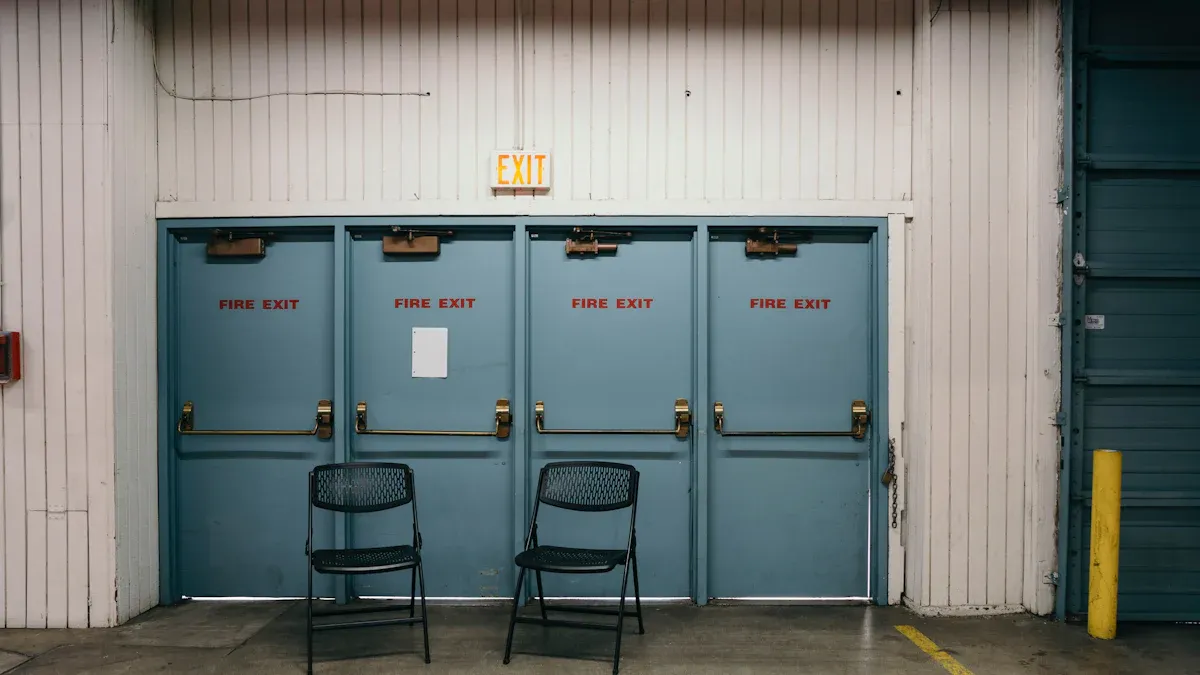
Fireproof doors for industrial buildings are essential for safety. These fireproof doors for industrial buildings help protect people and property by slowing the spread of flames, smoke, and heat during a fire. This delay provides crucial extra time for evacuation and reduces overall damage. Industrial buildings face unique fire hazards, including:
- Electrical wiring and lighting that can ignite fires.
- Heating equipment and tasks like welding that increase fire risks.
- The presence of flammable gases, liquids, and dust that require careful management.
Adhering to fire safety regulations and conducting regular inspections are key to minimizing these risks. Facility managers should review their fire safety strategies and consider how fireproof doors for industrial buildings can enhance overall protection.
Key Takeaways
- Fireproof doors help keep people and things safe. They slow down fire, smoke, and heat. This gives everyone more time to leave safely. These doors are made with strong materials. They have special seals and hardware. These parts help stop fire and smoke. The doors must follow strict safety rules. There are many types of fireproof doors. Some are hollow metal, roll-up, sliding, swinging, or access doors. Each type fits different needs in factories. Fireproof doors need regular checks and care. This helps them work well and follow safety laws. Staff should get training on fire doors. Fire doors should work with fire alarms. This makes the building safer and helps stop fire damage.
What Are Fireproof Doors?
Fireproof doors, also called fire rated doors, are very important for safety in factories. Fire safety experts say these doors are made to stop fire and smoke for a certain amount of time. They keep their shape and work even when there is a fire. Rules like UL 10C and NFPA 80 tell how to make, test, and put in these doors. These doors are a big part of passive fire protection systems. They help split up buildings and keep people and things safe during emergencies. Laws say you must use them in places like stairwells and fire zones to keep everyone safe and follow the rules.
Key Features
Fireproof doors for industrial buildings are different from regular doors because they are built with special parts.
- They have fire-resistant materials like steel, gypsum, or vermiculite cores for strength and insulation.
- They use special hardware like automatic door closers, fire-resistant locksets, and hinges that can take high heat.
- Panic hardware lets people get out fast if there is an emergency.
- Smoke and intumescent seals get bigger when hot, stopping smoke and flames.
- Strong frames stop the doors from bending or falling when it gets very hot.
- Self-closing and positive latching parts keep the doors shut during a fire.
- Testing and certification by groups like UL and NFPA make sure the doors work well.
- Putting these doors in fire zones, stairwells, and hallways helps keep fire and smoke in one place and helps people get out safely.
How They Work
Fireproof doors act as walls that slow down fire and smoke in factories. Their strong materials and seals that grow bigger with heat make tight barriers. This keeps fire in one area and keeps escape paths safe. Smoke seals stop smoke from getting through cracks, which is important because smoke can hurt people in a fire. These doors can hold back fire and smoke for a set time, sometimes for hours, based on their rating. They need to be put in right and checked often to make sure they work. By staying strong during a fire, these doors give people more time to get out and help stop damage to the building.
Importance in Industrial Buildings
Fire Risks
Industrial buildings have many fire dangers. These dangers can hurt people and damage property. The National Fire Protection Association says electrical equipment often starts fires in these places. Heating equipment is also a big risk, especially in factories. Combustible materials, flammable liquids, and gases can make fires spread fast if they touch something hot.
Some common reasons for industrial fires are:
- Hot work like welding or cutting can make sparks and start fires.
- Electrical problems, such as bad wiring or too many things plugged in, cause about one-fourth of these fires.
- Machines can break or get too hot and start a fire.
- Industrial vehicles can catch fire if not cared for or after accidents.
- Storing or using flammable gases and liquids the wrong way can cause explosions.
Fireproof doors for industrial buildings help lower these risks. They act as barriers to keep fire and smoke in one place. This slows down the fire and keeps escape paths safe. These doors stay strong in high heat and use seals to stop smoke and gases. By holding fire in one area, they give people more time to leave and help protect equipment and supplies.
Safety Standards
Strict rules tell us how to use fireproof doors in industrial buildings. These rules make sure the doors work well during a fire. The table below shows some important rules:
| Standard/Test Type | Description |
| Fire Ratings | 20, 45, 60, 90, 180 minutes certified by third-party agencies |
| Applicable Codes | NFPA 80, NFPA 101, IBC, IFC |
| Testing Standards | UL 10B, UL 10C (positive pressure), NFPA 252 |
| Fire Endurance Test | Exposure to heat up to 1925°F for up to 180 minutes; door must remain intact and limit flame passage |
| Hose Stream Test | Water stream at 30 psi from 20 feet after fire test; 20-minute doors usually exempt |
| Temperature Rise Ratings | Limits heat transmission; ratings of 250°F, 450°F, or 650°F over 30 minutes |
| Smoke and Draft Control | Some doors require UL 1784 testing for smoke infiltration |
| Door Features | Must be self-closing and positively latching |
| Glazing Requirements | Fire-rated glass with additional fire and safety requirements |
Note: Fire doors must be checked every year to make sure they work. Labels must be easy to see. All parts of the door, like frames, hardware, and glass, must meet the same rules.
By following these rules, managers help make sure fireproof doors for industrial buildings keep people safe. Meeting these rules also helps with insurance and legal needs.
Types of Fireproof Doors for Industrial Buildings
Industrial buildings need different fireproof doors for safety. Each door type has special features and fire ratings. Some doors are better for certain places in a building. The best door depends on the building’s shape and fire risk. It also depends on how people use the space.
Hollow Metal Doors
Hollow metal doors are used a lot in factories. They are made with steel sheets and strong supports inside. The middle part is filled with stuff that stops heat and flames.
- Hollow metal doors can stop fire for 20 to 90 minutes. Some can last up to 180 minutes in risky spots.
- These doors keep their shape and strength when it gets very hot.
- Some doors limit heat on the safe side to 250°F, 450°F, or 650°F in 30 minutes. This helps keep escape paths and equipment safe.
- Groups like UL test these doors to make sure they are safe.
Hollow metal doors are good for hallways, stairs, and main doors where strong fire protection is needed.
Roll-Up & Overhead Doors
Roll-up and overhead doors are used for big openings in factories.
- Roll-up doors have steel slats that roll up above the door. This saves space and lets them open fast.
- Overhead doors have panels that move up and down. They help keep heat in and let trucks and machines pass.
- These doors can stop fire for 45 minutes to 4 hours, based on the type.
- They have systems that close the door by themselves if there is a fire.
- Many roll-up doors are approved by UL and Factory Mutual for safety.
Main benefits of roll-up and overhead doors:
- They save space where there is not much room above.
- They are strong and help keep things safe.
- Some doors have insulation to save energy and control temperature.
- You can get them in different sizes and looks for your needs.
Rolling fire doors help keep fire and smoke in one area. This protects people and things in busy factory spaces.
Sliding & Swinging Doors
Sliding and swinging doors are good for many building shapes and spaces.
- Swinging fire doors are the most used. You push or pull them to open. They can close by themselves or be automatic. They are easy to use and fix, so they work well in halls, stairs, and exits.
- Sliding fire doors move sideways on tracks. They are best for big openings or tight spots, like near machines or storage. They save space and let big things move through.
Good things about sliding and swinging fireproof doors:
- Both types stop fire well, with ratings from 60 to 180 minutes.
- Sliding doors are often made with steel or special metals for more safety.
- They can close by themselves when the fire alarm goes off.
- Swinging doors are easy to put in and use. Sliding doors help save space.
Sliding and swinging fireproof doors keep fire and smoke in one place. This gives people more time to get out and helps firefighters.
Fire-Rated Access Doors
Fire-rated access doors let people get into utility rooms and panels safely.
- These doors must pass tough tests like UL 10B and UL 10C. The tests check if they can stop fire, smoke, and heat for a set time.
- Access doors usually stop fire for 20 to 90 minutes, depending on where they are used.
- Each door has a label that shows its fire rating and who tested it.
- They need special fire-rated parts, like hinges and locks, to stay closed during a fire.
Fire-rated access doors help keep fire barriers strong and make sure the building follows safety rules.
Comparison Table: Main Types of Fireproof Doors for Industrial Buildings
| Door Type | Construction/Features | Typical Applications | Fire Ratings (Minutes) | Certification |
| Hollow Metal Doors | Steel sheets, insulated core, reinforced | Corridors, stairwells, entry points | 20, 45, 60, 90, 180 | UL, NFPA |
| Roll-Up/Overhead | Steel slats or panels, space-saving, insulated | Warehouses, docks, large openings | 45, 60, 90, 180, 240 | UL, FM |
| Sliding Doors | Steel or alloy, track-mounted, space-efficient | Machinery access, storage, tight spaces | 60, 90, 180 | UL, NFPA |
| Swinging Doors | Hinged, self-closing, easy operation | Corridors, exits, stairwells | 20, 45, 60, 90, 180 | UL, NFPA |
| Access Doors | Small, insulated, labeled, fire-rated hardware | Utility rooms, electrical/mechanical panels | 20, 45, 60, 90 | UL 10B, UL 10C |
Tip: Always make sure fireproof doors for industrial buildings have clear labels and the right fire rating for where they are used.
Materials & Fire Ratings
Steel
Steel is the most used material for fireproof doors in factories. Makers use thick steel sheets that do not burn. These sheets are sometimes galvanized or stainless. Steel doors can stop fire for 30 minutes to four hours. The time depends on the fire rating. Steel does not burn fast and keeps its shape in heat. Builders put mineral cores like gypsum or vermiculite inside the steel. This makes the door even better at stopping fire. Intumescent seals and fire-rated hardware help block smoke and flames. This is why steel doors are a safe choice.
- Steel doors give:
- Great strength and fire protection
- Little bending or breaking from heat
- Good barriers for escape paths
Wood
Wood doors are not used much in factories for fire safety. Solid timber cores can slow fire a bit. But wood can still burn, bend, or crack in high heat. This makes it weaker at stopping fire. Some wood doors have mineral or composite cores and special coatings. These help them work better. Still, steel doors protect much more in most factories.
Glass & Ceramic
Glass and ceramic fireproof doors use special glass called fire-rated glazing. Ceramic glass can take high heat and stops smoke and flames. When used with the right frames and seals, these doors help keep fire out of exits and escape paths. But ceramic glass does not stop radiant heat. So, building codes limit how much and where it can be used. Fire resistive glazing can stop both flames and heat. This lets builders use bigger glass panels in more places.
Note: You must install and check glass and ceramic fireproof doors often to keep them working well.
Fire Rating Durations
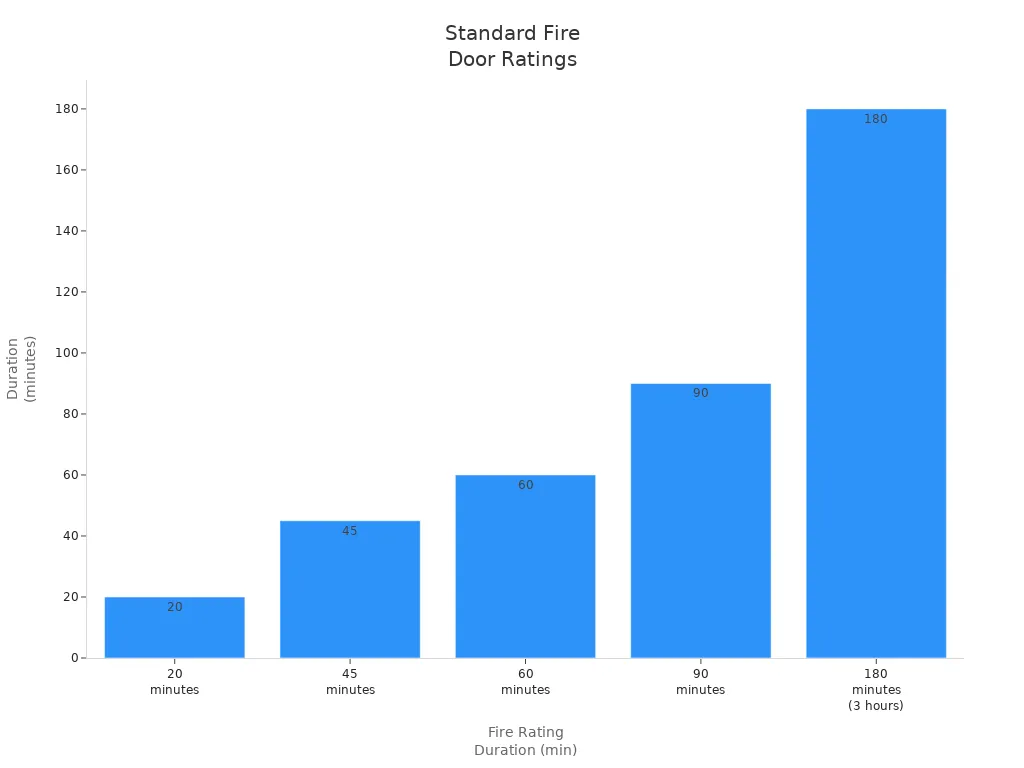
Fireproof doors for factories have different fire rating times. These ratings show how long a door can stop fire and smoke in a test. Ratings go from 20 minutes to 3 hours. The time depends on the door type and where it is used. For example, stairwell doors may need to stop fire for 60 to 120 minutes to keep escape paths safe.
| Fire Rating Duration | Typical Use in Industrial Buildings |
|---|---|
| 20 minutes | Corridors needing smoke and draft control |
| 45 minutes | Room partitions, moderate exterior fire exposure |
| 60 minutes | Occupancy separations |
| 90 minutes | Stairwells, elevator shafts, boiler rooms |
| 180 minutes (3 hrs) | Walls dividing fire areas or separating buildings |
Installation Locations
High-Risk Areas
Industrial buildings have places where fire risks are high. Facility managers put fire doors in these spots to keep people and property safe. Some high-risk areas are:
- Boiler rooms and mechanical spaces
- Server rooms with important electronics
- Storage rooms for chemicals or things that can burn
- Kitchen exhaust ducts and food prep areas
- Near heating and cooling machines
- Doorways that link or split different buildings
- Elevator shafts and stairwells
These places need strong fire protection. Fire doors here help stop fire and smoke from moving fast. They also keep dangerous materials away from public areas.
Escape Routes
Getting out safely is very important in an emergency. Fire doors are important along escape routes. They keep halls, stairs, and exits free from smoke and fire. Some helpful features are:
- Intumescent seals that get bigger with heat to block spaces
- Strong steel frames and fire-resistant hardware
- Self-closing parts to make sure doors stay shut in a fire
Fire doors keep escape paths safe so people have more time to leave. They also help first responders reach people who need help. Good installation and regular checks make sure these doors work when needed.
Tip: Always check that fire doors on escape routes have clear labels and follow local safety rules.
Compartmentalization
Compartmentalization means splitting a building into smaller sections. Each section has fire-resistant walls, floors, and doors. This setup keeps fire and smoke in one spot, which limits damage and saves lives. Some key things about compartmentalization are:
- Fire barriers and walls make separate zones
- Fire-rated walls and doors slow down fire
- Compartmentalization keeps escape routes safe and gives more time to get out
- Regular checks and upkeep keep these systems working well
- Staff training and clear emergency plans help keep everyone safe
Compartmentalization is a big part of passive fire protection. It helps industrial buildings follow safety rules and lowers the chance of big fire damage.
Inspection & Maintenance
Regular Checks
Checking fire doors often keeps them ready for emergencies. NFPA 80 says a licensed company must check fire doors every year. Facility workers can look at doors every month or two to find problems early. These checks help keep people safe and follow the law.
- Look at fire doors at least once each year.
- Check more often in busy or risky places.
- Look at seals, closers, and latches for damage or wear.
- Rolling fire doors need yearly checks and drop tests to make sure they close by themselves.
- Write down all checks for insurance and rules.
Tip: Checking doors often helps find small problems before they get worse.
Common Issues
Inspections can find problems that stop doors from working right. Fixing these problems fast makes sure doors work in a fire.
| Common Issue | Description |
|---|---|
| Faulty or Damaged Closers | Doors should close all the way and latch tight. |
| Loose Door Hinges | Hinges must be tight and oiled so doors close right. |
| Faulty Latching Mechanisms | Locks must work well; if not, they need fixing. |
| Problems With Intumescent Seals | Seals must be whole to block smoke and fire. |
| Blocked or Propped Doors | Never wedge or block doors open. |
| Missing or Obscured Signage | Labels must be easy to see and read. |
| Warping or Distortion | Doors should not be bent or have gaps that let fire through. |
Note: Teaching staff helps stop doors from being blocked or used wrong.
Compliance
Taking care of fire doors helps meet safety rules. NFPA 80 gives the rules for checking, testing, and fixing doors.
- Gaps under doors must be less than 3/4 inch; side and top gaps less than 1/8 inch.
- Oil moving parts and fix alignment if needed.
- Use only approved parts for hinges, latches, and closers.
- Keep fire-rated glass sealed and not broken.
- Only let trained people fix doors with approved parts.
- Make sure labels on doors, frames, and hardware are easy to see.
- Write down all checks, fixes, and changes with dates and details.
- Keep doorways clear for emergencies.
Testing doors often and fixing problems right away keeps them safe and legal.
Best Practices
Staff Training
Teaching staff the right way to use fire doors is important. Workers need to know why fire doors matter for safety. Training should show how to use fire doors the right way. It should also explain why doors must stay closed. Staff should learn to see problems like doors that do not fit or broken seals. They need to know how to tell someone if there is a problem so it gets fixed fast. Teaching workers often helps them remember to keep doorways clear. Training also teaches what to do in an emergency, like using fire doors when leaving the building. Maintenance workers should learn how to check doors and write down what they find. Only trained experts should put in, fix, or do hard work on fire doors. This keeps fire doors working well and helps follow safety rules.
Tip: Keep having training sessions so everyone remembers what to do and stays safe.
Integration with Fire Systems
Newer industrial buildings use fire doors with fire detection and suppression systems. These systems watch for smoke or heat and can turn on sprinklers or gas systems. When a fire is found, the system tells fire doors to close by themselves. This keeps fire and smoke in one area and protects ways out. It also helps stop damage. Connecting fire doors to a building management system lets people watch and control things in real time. Smart detection can warn people sooner and help them act faster. Checking and testing fire doors and all systems often makes sure they work together in a fire. This way, everyone is safer and the building follows fire safety rules.
Note: Using fire doors with automatic systems makes buildings much safer from fire dangers.
Fire-rated doors have lots of benefits for factories.
- They help slow down fire and smoke. They keep people safe and protect things from damage.
- These doors also make buildings safer, save energy, and help follow the rules.
- Checking doors often, like looking at seals and closers, keeps them ready for emergencies.
- Managers should look at fire safety plans, teach workers, and ask experts for help with putting in and fixing doors.
Taking care of fire-rated doors and getting help from professionals keeps everyone safe and follows the rules for a long time.
FAQ
What is the difference between a fireproof door and a regular door?
A fireproof door has special materials and seals. These help stop fire and smoke from spreading. Regular doors cannot block fire or heat for long. Fireproof doors help keep people and things safe in emergencies.
How often should fireproof doors be inspected?
Experts say to check fireproof doors at least once a year. In busy or risky places, you may need to check more often. Regular checks make sure doors work and follow safety rules.
Can fireproof doors be left open during normal operations?
No, fireproof doors should stay closed. You can use special hold-open devices that close the door if there is a fire. Open doors cannot stop fire or smoke. This can put people and property in danger.
Are fireproof doors required by law in industrial buildings?
Yes, most building codes and fire safety rules say you must have fireproof doors in some areas. These rules help keep escape paths and risky rooms safe. They also help with insurance and legal needs.


