
Have you ever wondered how to fix problems with your hospital fire door? Safety in hospitals starts with doors that work the right way. You must keep everyone safe and follow the rules. NFPA 80 says you need regular checks and maintenance. Good hospital fire door care helps you stay ready for emergencies and keeps your building safe for everyone.
Key Takeaways
- Always look at hospital fire door labels to make sure you can see them and they are certified. Do not paint over or take off the labels.
- Check door hardware like latch bolts, strike plates, closers, and handles often. This helps doors work the right way.
- Measure and fix door gaps so smoke and fire cannot get through. Follow NFPA 80 rules very carefully.
- Keep fire doors free from things that block them. Use hold-open devices the right way so doors close in emergencies.
- Keep good records of checks and repairs. This shows you follow safety rules and keeps your hospital ready.
Labels & Certification
Verifying Labels
You must look at every fire door label in your hospital. NFPA 80 says all fire doors, frames, and exit devices need labels you can see and read. These labels show the fire rating and prove the door is safe. Never paint over or take off these labels. If you do, you might fail inspections and break the rules. Only certified inspectors, like those from the Door and Hardware Institute or the International Fire Door Inspector Association, can check or put on new labels.
Tip: Keep labels clean so people can read them. If a label is gone or broken, get a certified inspection fast.
Hospitals have to follow strict rules for labels. The Joint Commission and other groups check these labels during inspections. If a hospital fire door does not have the right label, it might not pass inspection. Some groups, like Health Choice Enterprises, have special approval to give field labels and write reports.
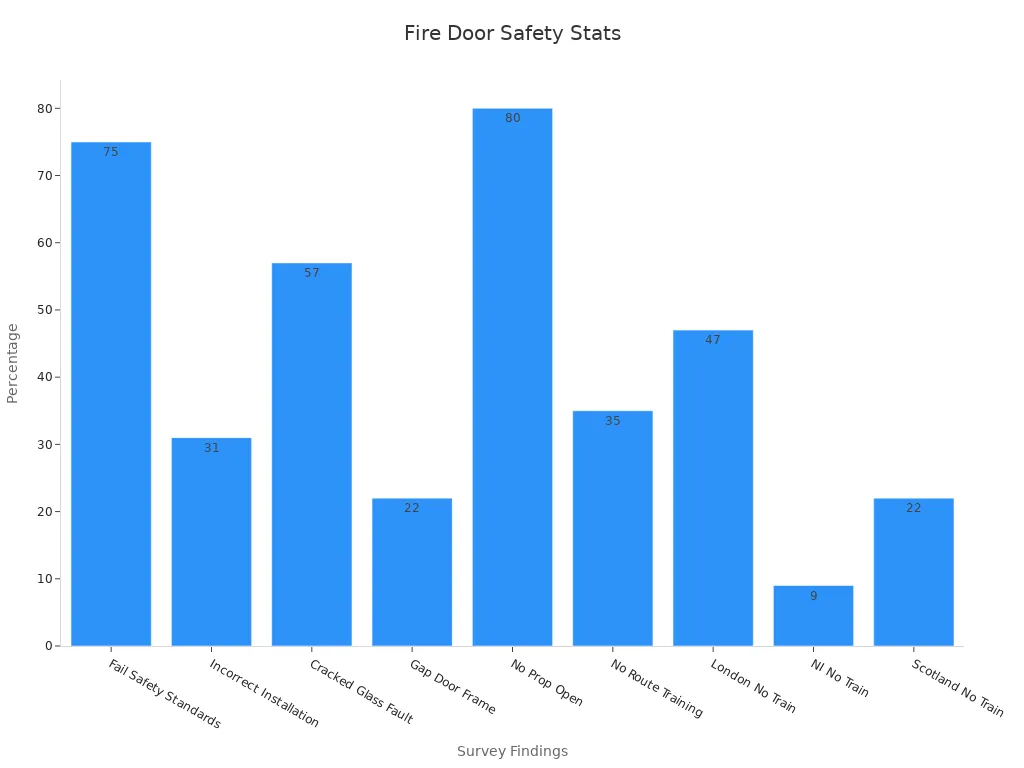
Here is a table with important facts about fire door checks and rules:
| Survey Statistic / Finding | Data / Description |
|---|---|
| Fire Doors Failing Safety Standards | 75% of fire doors in UK failed to meet required safety standards |
| Incorrect Installation | 31% of fire doors incorrectly installed from the start |
| Worker Awareness of Fire Door Faults | 57% recognized cracked glass as a fault; 22% recognized gaps around door frame as a fault |
| Workers Understanding of Fire Door Use | 80% understood fire doors should not be propped open |
| Fire Exit Route Training | 35% of respondents had not been shown fire exit routes at work |
Common Mistakes
Many hospitals make mistakes with fire door labels. The most common problems are:
- Painting over or taking off labels, so you cannot read them.
- Letting people who are not allowed put on or move labels.
- Changing doors in the field without a certified lab, like UL or Intertek, checking or relabeling them.
- Not teaching staff to spot label problems or know the rules.
Note: Only listing laboratories can approve or put on field labels. Manufacturers cannot add labels in the field unless a listing lab checks the door.
These mistakes can make you break NFPA 80 and Joint Commission rules. Always follow the right steps for labels and keep your hospital fire door labels easy to see and not damaged.
Hardware Inspection
Latch Bolts & Strike Plates
You need to check latch bolts and strike plates on every hospital fire door. These parts keep the door closed during a fire. If a latch bolt does not work, the door may not stop smoke or flames. Use your hand to test the latch. It should move smoothly and snap into place. Look at the strike plate. Make sure it lines up with the latch and is not loose or damaged.
Tip: If you see scratches, dents, or missing screws, fix them right away. Even small problems can cause the door to fail in an emergency.
Regular hardware inspections help you find these issues early. Studies show that over 82% of fire-related deaths and property loss happen when fire doors do not work right. When you inspect and repair hardware, you lower the risk of injury and damage. You also avoid costly repairs later.
Closer Arms & Handles
Check closer arms and handles every time you inspect a hospital fire door. The closer arm should pull the door shut without slamming or leaving it open. If the door closes too fast or too slow, adjust the closer. Handles must turn easily and not stick. If you feel resistance or see loose parts, replace them.
- Make sure the closer arm is tight and not leaking oil.
- Test the handle by opening and closing the door several times.
- Listen for squeaks or grinding sounds.
Regular checks keep all parts working together. Fire doors face wear and tear every day. Even one broken part can let fire or smoke spread. When you inspect hardware often, you protect patients and staff. You also meet NFPA 80 rules and keep your hospital safe.
Door Gaps & Clearance
Measuring Gaps
You must measure the gaps around every hospital fire door. These gaps help the door work right during a fire. If the gaps are too big, smoke and flames can pass through. If the gaps are too small, the door might not close or latch. The NFPA 80 standard gives you clear rules for these measurements. The bottom gap should not be more than three-quarters of an inch. The gap at the top and sides should not be more than one-eighth of an inch. The Joint Commission also checks these measurements during inspections.
Tip: Use a simple ruler or a gap gauge to check the space at the top, bottom, and sides of the door. Always measure when the door is closed.
NFPA 80 and NFPA 101-2012 both set these limits to keep everyone safe. Gaskets can help close small gaps if needed. These standards make sure all hospitals follow the same rules. They help you pass inspections and keep your building safe.
A study by ASHE and the Fire Protection Research Foundation looked at these gap sizes. The study found that these measurements have been used for many years. Experts plan more tests to see how gap size affects fire door safety. For now, you should always follow NFPA 80 for your hospital fire doors.
Adjusting Hardware
If you find a gap that is too wide or too narrow, you need to adjust the door hardware. Start by checking the hinges and screws. Tighten any loose parts. If the door still does not fit right, you may need to adjust the strike plate or the door closer. Sometimes, you must add or replace gaskets to fix small gaps.
- Check the hinges for wear or damage.
- Make sure the door sits square in the frame.
- Adjust the strike plate so the latch lines up.
- Add gaskets if the gap is just a little too big.
Note: Always fix gap problems right away. Even a small gap can let smoke or fire through in an emergency.
Regular checks and quick fixes help your fire doors work as they should. You keep patients and staff safe, and you meet all the rules for hospital fire doors.
Hospital Fire Door Inspections
Inspection Frequency
You have to check every hospital fire door often. Most fire safety codes, like NFPA 80 and the International Fire Code, say you must check each door at least once a year. Many hospitals check doors every six months, especially in busy places. Doors in main halls or emergency exits may need more checks. Some experts say to check these doors every week or month if they get used a lot.
Tip: Make a checklist for your team. Add steps for looking at the door, testing how it works, and checking fire safety parts.
A good check looks at more than just the door. You should look at the door leaf, frame, hardware, seals, and signs. After you fix or put in a door, check it again to make sure it works right. Always write down what you find in each check. This helps you show you follow the rules and keeps everyone safe.
Here is an easy schedule for checks:
- Weekly: High-traffic routes and emergency exits
- Monthly: Main entrances and busy halls
- Annually: Office doors and less-used areas
NFPA 80 Standards
NFPA 80 gives clear rules for hospital fire door safety. You must check that the gap between the door and frame is not more than 1/8 inch. The gap under the door should not be more than 3/4 inch. Fire doors have ratings from 20 minutes up to 3 hours. Make sure each door has the right fire resistance for its spot.
When you check, look for broken seals or missing labels. Test the door to see if it closes and latches right. Rolling steel doors must close by themselves at a safe speed. Always follow the maker’s instructions for any fixes or upgrades.
Note: Good records and regular checks help you meet NFPA 80 rules and keep your hospital safe.
Seals & Integrity
Checking Seals
You need to check the seals on every hospital fire door to keep your building safe. Seals stop smoke and fire from spreading through gaps around the door. You should look at both intumescent and smoke seals. These seals often run along the edge of the door or frame.
- Look for tears, cracks, or missing pieces in the seals.
- Check if any part of the seal has come loose or fallen off.
- Make sure the seal sits flat and covers the gap.
Visual inspection is the best way to check the condition of seals. You do not need special tools. Just use your eyes and hands. NFPA 80 says you must inspect seals as part of your yearly fire door check. If you find a problem, write it down in your inspection records. Good records help you show that you follow safety rules.
Tip: Always check seals after any repairs or changes to the door. This helps you catch problems early.
Replacing Damaged Seals
If you find a damaged seal, you must replace it right away. A broken seal can let smoke or fire pass through, which puts patients and staff at risk. You can buy replacement seals that match the type and size used on your hospital fire door.
Follow these steps to replace a seal:
- Remove the old, damaged seal.
- Clean the area where the new seal will go.
- Press the new seal into place, making sure it fits tightly.
- Check that the door closes and latches with the new seal.
Keep a record of every seal you replace. This helps you track repairs and stay ready for inspections. When you keep seals in good shape, you protect everyone in your hospital.
Obstructions & Blockages
Keeping Doors Clear
You must keep hospital fire doors free from obstructions at all times. When you block a fire door with carts, beds, or boxes, you put everyone at risk. Fire doors need to close quickly in an emergency. If something blocks the door, smoke and fire can spread fast. You should train your staff to spot and remove anything that blocks a fire door.
Tip: Place clear signs near fire doors that say, “Do Not Block.” This helps remind everyone to keep the area clear.
Make a habit of checking fire door areas during your daily rounds. If you see something in the way, move it right away. You can also use a checklist to help your team remember to look for obstructions. When you keep fire doors clear, you help protect patients, staff, and visitors.
Here is a simple checklist for keeping fire doors clear:
- Look for carts, beds, or equipment near fire doors.
- Remove any items blocking the door or the path to the door.
- Remind staff and visitors about the importance of clear fire doors.
Hold-Open Devices
Hold-open devices help you manage fire doors in busy hospital areas. These devices keep fire doors open during normal use. When a fire alarm sounds, the device releases the door so it closes by itself. This stops fire and smoke from spreading.
You should know that modern hold-open systems follow strict safety standards. They include fire detectors, trigger mechanisms, and power supplies. Some systems even have wireless features, making them easy to add to older buildings. Experts must install these devices and check them often. Monthly checks and yearly maintenance keep the system working right.
- Hold-open devices must release doors automatically when fire is detected.
- Certified systems meet standards like DIN 14677 and EN 14637.
- You need regular inspections and expert installation for safety.
- New wireless options make upgrades easier in existing hospitals.
Note: Always test hold-open devices during fire drills. This helps you make sure the doors close as they should in an emergency.
When you use and maintain hold-open devices correctly, you keep your hospital safe and ready for any emergency.
Accessibility & Usability
ADA Compliance
You need to make sure every hospital fire door follows ADA rules. Heavy fire doors can be tough for some people to open. Patients, visitors, and staff with limited movement may have trouble. Some people try to wedge these doors open to make it easier. But this is not safe and breaks fire codes. A safer way is to use door retainers. These hold fire doors open safely and let them close in emergencies. This keeps everyone safe and follows ADA and fire safety rules.
Hospitals sometimes have a hard time meeting ADA rules. This is true in places like behavioral health or bariatric units. These areas need special hardware or more space. For example, bariatric rooms need wider doors. Behavioral health units need anti-ligature handles. You should work with designers and builders to find the best way to keep things safe and easy to use.
Here is a table with important ADA door rules:
| ADA Door Compliance Criteria | Specification |
|---|---|
| Door Width | Minimum 32 inches clear opening |
| Opening Force | 5 lbs or less to open/close |
| Closing Speed | At least 5 seconds to close |
| Door Handles | Lever handles required |
| Threshold Height | Max 1/8 inch for fire-rated doors |
| Clearance Under Door | Max 1/8 inch for fire-rated doors |
| Hardware Operation | Operable with one hand, no twisting or pinching |
Tip: Teach your staff to look for doors that do not meet these rules and report them.
Adjustable Closers
Adjustable closers help you meet both safety and ADA needs. You can set how fast and hard the door closes. This helps people with less strength use the door. It also keeps fire doors working right.
A good closer lets the door close in at least five seconds from being wide open. This matches ADA rules and gives people enough time to walk through. Adjustable closers let you change how fast and hard the door latches. This stops the door from slamming or staying open too long.
| Metric Description | Requirement / Performance Metric | Why It Matters |
|---|---|---|
| Minimum closing time (90° to 12°) | At least 5 seconds | Prevents doors from closing too fast |
| Spring power adjustment | Controls closing force | Ensures easy operation for all users |
| Separate speed/latch adjustments | Fine-tunes closing and latching | Improves safety and usability |
When you set closers the right way, you help everyone move safely and keep fire doors ready for emergencies.
Compartmentalization
Fire-Resistant Barriers
You can help keep your hospital safe by using fire-resistant barriers. These barriers include fire doors, walls, floors, and special curtains. They break the building into smaller zones. If a fire starts, these barriers slow it down. This gives people more time to leave safely.
Fire-resistant barriers work because they are made from strong materials. These materials can handle heat and flames. Tests like ASTM E119 and UL 263 check if barriers stay strong during real fires. These tests make sure doors and walls do not let too much heat through. You must also follow rules from NFPA 101 and the International Fire Code. These codes say you should check and fix barriers often. You need to keep records of every check and repair.
Tip: Put clear signs on all fire doors and barriers. This helps staff and visitors find safe exits in an emergency.
Here are some ways compartmentalization helps your hospital:
- Use fire-resistant materials and doors to make safe zones.
- Add smoke barriers and curtains to control where smoke goes.
- Mark escape routes and fire equipment so people find them fast.
- Have regular fire safety meetings to keep your team ready.
Updating Risk Assessments
You need to update your fire risk assessments often. Hospitals change as time goes on. New equipment, building changes, or new patient needs can change fire safety. When you update your risk assessment, you find new dangers and fix them before they cause trouble.
Compartmentalization makes these updates easier. You can check each zone for weak spots. Look for broken barriers, missing seals, or blocked doors. Make sure your fire safety plan matches how your hospital looks now.
- Compartmentalization keeps patients, staff, and equipment safe from fire and smoke.
- It helps firefighters by keeping smoke and flames in one area.
- Regular risk assessments keep your safety plan strong and up to date.
Keeping your risk assessments up to date means your hospital is ready for any emergency. You protect lives and follow all safety rules.
Signage & Instructions
Placement
You need to place fire door signs where everyone can see them right away. Good placement helps staff, patients, and visitors know which doors are fire doors and how to use them. Hospitals often use color-coded door frames. For example, blue frames show smoke doors, and red frames show horizontal exit doors. This color system helps people find the right door fast during an emergency.
You should put signs at eye level. Engraved red signs on fire and smoke doors work well. These signs remind everyone about the door’s purpose. Small, clear labels above the door strike can also help. These labels tell you that the door is a fire door and should not be propped open or blocked.
Tip: Place signs on both sides of the door. This way, people see the message no matter which way they walk.
A good placement plan makes it easier for staff to follow safety rules. It also helps new employees and visitors understand what to do in an emergency.
Visibility
You must make sure fire door signs are easy to see at all times. Bright colors and bold letters catch attention. Signs should stand out against the door and wall. Hospitals often use engraved or printed red signs because red means danger or emergency. This color choice helps people react quickly.
Here are ways to improve sign visibility:
- Use large, bold fonts that are easy to read from a distance.
- Avoid placing signs behind equipment or furniture.
- Keep signs clean and free from damage.
| Sign Feature | Why It Matters |
|---|---|
| Bold, large letters | Easy to read in a hurry |
| High-contrast colors | Stand out in low light or smoke |
| Eye-level placement | Visible to everyone, including kids |
Even with good signs, some people may still misuse fire doors. Ongoing training and reminders help everyone remember the rules. You can also use physical solutions like door release magnets or code-compliant hold-open devices to prevent misuse. Clear, visible instructions save lives by making sure fire doors work as they should during an emergency.
Maintenance & Records
Scheduling
You need to make a plan for checking each hospital fire door. Regular checks help your doors work and keep everyone safe. Experts say you should check fire doors once every year. You also need to check them after putting in new doors or making repairs. Always have trained staff or certified fire safety technicians do these checks. They look at door closers, labels, hinges, gaps, and latches. This routine helps you find problems before they get worse. If you follow a schedule, your hospital fire doors will be ready for emergencies.
Tip: Use your calendar or a maintenance app to remind you about inspections.
Documentation
Good records show you care about safety and follow the rules. You must write down details about every inspection and repair. This means the date, what you checked, who did it, and what happened. You should also keep a list of all your fire doors and any changes made during building or repairs. Use a computerized maintenance management system (CMMS) to track everything. This makes it easy to find records when someone comes to inspect.
Here is a checklist for keeping good records:
- Write the name and date for each inspection or repair.
- List every hospital fire door and where it is.
- Record who did the work and their skills.
- Note what happened and any repairs or retests.
- Keep all records together in one place, like a notebook or computer file.
| Documentation Item | Why It Matters |
|---|---|
| Inspection dates | Shows regular maintenance |
| Technician credentials | Proves qualified staff did the work |
| Repair records | Tracks fixes and follow-up actions |
| Device inventory | Helps you manage all fire doors |
When you keep good records, inspections are easier and your hospital stays safe. Work with facility managers, engineers, and maintenance staff to keep your records complete and up to date.
You help keep your hospital safe every day. Checking fire doors often and fixing problems early stops bigger issues. Work with your team to look at doors, fix things, and write down what you do. If you are not sure about something, ask a fire safety expert or read the newest safety rules. Doing these things keeps everyone safe and helps you follow all the rules.
FAQ
What should you do if a fire door will not close properly?
Check for obstructions or damaged hardware. Tighten loose screws and adjust the closer. If the door still will not close, contact a certified technician. Never leave a fire door stuck open.
Tip: Always report broken fire doors to your safety team.
How often should you inspect hospital fire doors?
You should inspect fire doors at least once a year. In busy areas, check them every six months or more often. Regular checks help you find problems early and keep everyone safe.
Can you paint over fire door labels?
No, you should never paint over fire door labels. Labels must stay visible and easy to read. If a label gets covered or damaged, ask a certified inspector for help.
Who can repair or replace fire door hardware?
Only trained staff or certified fire door technicians should repair or replace hardware. Using the wrong parts or tools can make the door unsafe. Always follow the manufacturer’s instructions.
- Certified technicians know the correct steps.
- Proper repairs help you pass inspections.
Why do you need to keep fire doors clear of obstructions?
Obstructions stop fire doors from closing. If a fire starts, a blocked door cannot protect people from smoke or flames. Always keep the area around fire doors clear.
Remember: Clear fire doors save lives.


