
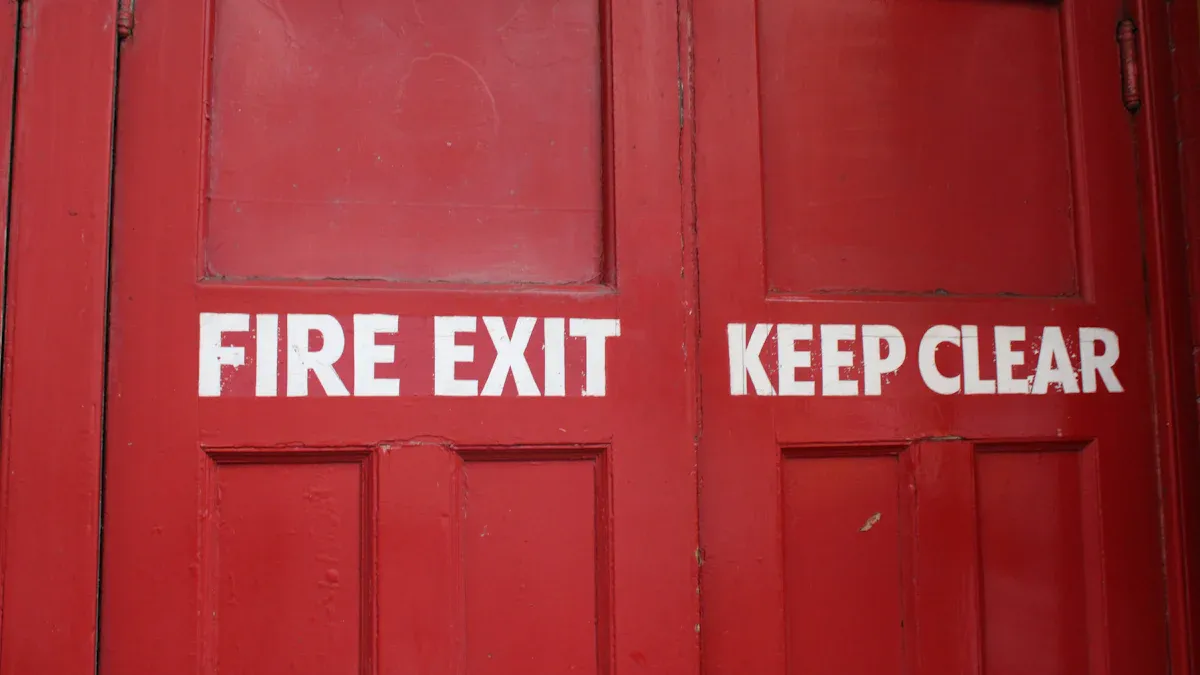
You see fireproof doors in lots of buildings, but do you know how they get so strong? Makers begin with special materials that pass safety rules. They use careful ways to make each piece. Every door goes through hard tests in trusted labs. These tests show the door can stop fire and keep people safe when needed. By doing these things, the final door is ready to protect you.
Key Takeaways
- Fireproof doors use strong materials like steel and mineral wool. These materials help stop heat and flames. Pick doors made with these materials for more safety.
- Every fireproof door must go through tough safety tests. These tests make sure the door can handle high heat. Check for labels that show the tests were done.
- It is important to check fireproof doors often. Look for spaces and broken seals at least once a year. This helps keep everyone safe.
- Fireproof doors have special parts like intumescent seals. These seals get bigger when they get hot. They help stop smoke and flames from spreading.
- Fireproof doors work better with good installation and care. Make sure all parts are certified and work well. This helps the doors protect you more.
Fireproof Door Materials
Certified Fire-Resistant Materials
A fireproof door is not like a normal door. It has many layers inside. These layers are made from special materials. These materials help stop fire from moving to other rooms. Makers use only certified fire-resistant materials. This makes sure the door can take a lot of heat and flames. Before using them, these materials must pass tough tests.
Here are some materials you will often see in a fireproof door:
- Solid timber core
- Mineral core
- Steel core
- Composite core
- Steel or aluminum facing
- Wood veneer
- Laminates
- Glass panels
- Intumescent seals
- Steel, timber, or aluminum frames
- Fire-resistant coatings and finishes, such as intumescent paint or fire-resistant varnish
Tip: Certified materials are very important. They help the door stay strong and keep its shape in a fire.
You can check how long each material protects against fire. Look at the fire resistance class in this table:
| Class | Fire Resistance Duration | Materials Used |
|---|---|---|
| A | 1.5 hours | Steel, Wood |
| B | 1 hour | Wood, Steel, Combination of Materials |
Insulation Layers and Core Components
The inside of a fireproof door is just as important as the outside. Insulation layers and core parts work together. They stop heat and flames from getting through. You will find these parts inside a fireproof door:
- Glass wool or mineral wool insulation, which keeps heat from passing through the door
- Intumescent seals that get bigger when hot, filling spaces to block smoke and fire
- Fireproof gaskets around the edges, which also grow to make a tight seal
A thick fireproof door works better. Thicker doors have more insulation, like solid timber or particleboard. This helps the door handle high heat. It also keeps the door from bending or breaking. Intumescent seals give extra safety by blocking fire and smoke. Picking a fireproof door with the right core and insulation helps keep people and things safe during a fire.
Design and Engineering
Compliance with Fire Safety Standards
Every fireproof door must follow strict safety rules. These rules help keep people and buildings safe in a fire. In the United States and Europe, there are important standards to follow. The table below lists some main standards:
| Standard | Description |
|---|---|
| EN 1634-1 | Tests doors and frames for fire protection for 30, 60, or 90 minutes. |
| EN 1634-3 | Checks if doors can block smoke. |
| NFPA 80 | Requires fire doors to be checked and cared for often. |
| NFPA 101 | Says some doors must be tested every year. |
You need to use these standards when designing and building doors. You must test the materials and hardware to see if they resist fire. Standards like AS 1530.4 and AS 1905.1 tell you how to test and what results are needed. The National Construction Code (NCC) says you must follow AS 1905.1 for fire doors and their parts. These steps make sure the doors can handle fire and heat.
Note: Following fire safety rules is not just about passing tests. It helps save lives and protects buildings by making sure every door works well.
Structural Design Elements
You need to focus on how each fireproof door is built. Good design stops fire, smoke, and heat from moving to other places. Here are the most important parts:
- Door leaf made from solid timber, steel, or mineral cores
- Frame that matches the fire rating, often made from steel or fire-rated aluminum
- Intumescent seals that expand when hot to block smoke and flames
- Fire-rated hardware like hinges, locks, and closers
- Glazing systems with fire-resistant glass
Each part does something special. The core, like steel, gypsum, or vermiculite, helps stop fire and keeps heat out. Intumescent strips get bigger when hot and fill gaps to block smoke. Strong frames hold the door steady during a fire. Special glass lets you see through the door but still keeps fire out.
| Feature | Contribution to Fire Rating |
|---|---|
| Steel, Gypsum, or Vermiculite Cores | Give strong fire protection and keep heat away. |
| Intumescent Strips or Seals | Grow bigger to block flames, smoke, and heat. |
| High-Temperature-Resistant Vision Panels | Use special glass to keep fire out. |
| Reinforced Frames | Stay strong and hold the door in place during a fire. |
You must pick each design part carefully. Every piece helps the door reach its fire rating and keeps people safe.
Manufacturing Process Steps
Precision Cutting and Shaping
First, you measure each part very carefully. You cut every piece so there are no gaps. Gaps can let fire or smoke get through. You use big saws and cutters to make straight edges. The core must be the same thickness everywhere. This helps the door work well in a fire. Before you attach anything, you put the parts together without glue. This is called dry-fitting. It helps you see if everything fits right. If something is wrong, you fix it now.
| Technique | Description |
|---|---|
| Measuring For Precision | The core is cut to match the exact door dimensions to avoid gaps that affect performance. |
| Using The Right Tools | Industrial saws and cutters ensure clean and straight edges for better material application. |
| Maintaining Consistent Thickness | A uniform thickness is crucial for the core’s performance in fire conditions. |
| Cutting and Joining | Frame pieces are cut to size and joined with strong joints to maintain shape and sealing. |
| Dry Fitting Components | Parts are assembled to check alignment before permanent fixing, allowing early issue detection. |
You check your measurements two times. This careful work makes the fireproof door strong and safe.
Welding and Spot Welding
Next, you join metal parts by welding. You use spot welding near the reinforcement plate. The welds are close together. Some parts need full welding. You polish these spots to make them smooth. Electric welding machines help you make strong welds. Automatic welding works better than doing it by hand. Good welds help the door last longer and stay safe in a fire. Bad welds can make weak spots that might break.
| Welding Method | Details |
|---|---|
| Spot Welding | Used around the reinforcement plate with a spacing of 20-30mm between solder joints. |
| Unilateral solder joints must have at least 3 points, ensuring firm welding without defects. | |
| Full Welding | Required on the welding plane interface, polished after welding to avoid defects. |
| Electric Welding | An electric welding machine is used for spot welding with a spacing of 50-100mm. |
Tip: Good welds help your fireproof door stand up to heat and pressure during a fire.
Fireproof Door Assembly
After cutting and welding, you put the door together. You build it in layers, starting with the fire-resistant core. This core makes the door strong and blocks heat. You add intumescent strips and gaskets to seal gaps. These strips get bigger when hot and stop smoke and flames. You fit the frame and make sure it matches the fire rating. Hinges, closers, and lock reinforcements go in next. Each part must be tested and certified. If you use the wrong hardware, the door may not protect you.
| Key Step | Explanation |
|---|---|
| Layered Construction | The door features a fire-resistant core that provides insulation and structural stability under high temperatures. |
| Sealing and Gasketing | Intumescent strips are used to fill gaps, preventing smoke and flames from seeping through. |
| Frame and Hardware Integration | The frame must be made of fire-resistant materials and designed to work with the door for effective performance. |
| Hardware Installation | Essential components like self-closing devices and positive-latching mechanisms ensure the door functions correctly during a fire. |
| Component Type | Description |
|---|---|
| Hinges | Certified fire-rated hinges are designed to withstand extreme heat, ensuring the door remains secure during a fire. |
| Closers | Fire door closers work with smoke and heat detectors to ensure automatic closing, preventing the spread of flames and smoke. |
| Lock Reinforcements | These must be certified and tested as part of the complete door assembly to maintain fire safety standards. |
- Every part must pass tough tests as part of the whole door.
- The whole fireproof door is checked for weak spots.
- Using the wrong hardware can put people and things in danger.
Flame Retardant Treatments
Last, you put on flame retardant treatments. These paints or coatings give extra protection. You cover every part of the door. This helps the door fight fire for a long time. Some treatments soak in, and some make a shield on top. You let the door dry and check for missed spots. This step helps the fireproof door meet safety rules and last longer.
Note: Flame retardant treatments are the last layer of defense. They help the door keep its strength and shape when there is a fire.
If you follow every step carefully, the fireproof door will protect people and property when it matters most.
Quality Control and Testing

Inspection Procedures
Every part of the door gets checked before leaving the factory. Careful checks help find problems early. Most fire doors do not pass the first check. This happens because there are wide gaps, missing seals, or broken closers. When you look at a door, you check each part closely. The table below shows what you need to look for:
| Component | Inspection Criteria |
|---|---|
| Door Frame | Must be attached well, with no damage or bending |
| Door Hardware | All parts should work and not be worn out |
| Door Leaf | Should not be bent, dented, or cracked |
| Intumescent and Smoke Seals | Must be whole and put in the right way |
| Glazing and Vision Panels | Should be fixed tightly and not damaged |
| Fire Door Gap | Gap must be between 2mm and 4mm |
| Self-Closing Device | Door should close all the way when let go |
| Labels and Signs | Must be there and easy to read |
Most doors fail the first check. You can stop this by checking every part carefully.
Fire Resistance Testing
You test the door to see if it can block fire and smoke. These tests use very hot heat and strong water sprays. The door goes in a furnace and gets heated to almost 2,000 degrees Fahrenheit. The door must stay strong for a set time, like 20, 45, 60, 90, or 180 minutes. After the fire test, you spray water on the door to see if it stays strong. The table below lists the main tests:
| Test Name | Description |
|---|---|
| UL 10B | Fire test with neutral or negative pressure |
| UL 10C | Fire test with positive pressure |
| NFPA 252 | Standard fire test for door assemblies |
| Fire Endurance | Door faces very high heat for up to 180 minutes |
| Hose Stream | Water sprayed at 30 psi from 20 feet after fire test |
These tests show if the door can keep people and things safe during a real fire.
Certification and Approval
You must follow strict rules to sell fireproof doors in different places. Each country has its own standards and approval steps. In North America, you need to test and certify doors with a special agency. In Europe, you must get CE Marking and follow European rules. In China, you need national certification for the door and its hardware. The table below shows the main rules:
| Market | Core Regulation/Standard | Certification Requirement |
|---|---|---|
| North America | US International Building Code (IBC) | Tested and certified by an independent ISO 17065 Accredited Agency; Listed by UL 10B, UL 10C or NFPA 252. |
| Canada | National Building Code of Canada | Rated to CAN/ULC S104 by a Standards Council of Canada accredited certification body. |
| Europe | Construction Products Regulation (CPR) 305/2011 | Products must be checked and certified by European Harmonized Standards; CE Marking is needed. |
| China | National standard GB 12955 “Fire Door” | Fire product certification is needed for fire doors and some hardware parts. |
You must follow these rules to make sure your door is safe and allowed to be used.
Final Assembly and Shipping
Hardware Installation
You must put in the hardware carefully. This keeps the fireproof door strong and safe. First, use long screws to fix the frame. Start on the hinge side. Drive 3-inch screws through shims into the framing. Next, go to the latch side. Adjust it so the gap stays even. Put fire-rated caulking around the frame. Fill every small gap to keep the fire rating. Test the door swing. Open and close the door many times. Make sure it swings easily. Check that it latches tight. The gap should look even all around.
- Fix the frame with screws on the hinge side.
- Use fire-rated caulking around the frame.
- Test how the door swings and fits.
The hardware you pick changes fire resistance and how the door works. See this table to learn how each material helps:
| Material Type | Fire Resistance Features | Functionality Benefits |
|---|---|---|
| Steel | Stops rust and handles high heat. | Lasts long and needs little care. |
| Fiberglass | Does not burn and melts above 2000˚F. | Makes little smoke, so it is safer. |
| Composite (WPC) | Burns slowly and does not catch fire easily. | Mixes wood and plastic for better fire safety. |
| Intumescent Materials | Grow bigger in heat to block fire and smoke. | Stops heat and smoke in emergencies. |
Surface Finishing
You need to finish the door’s surface to protect it. This also keeps the door looking nice. Powder coating makes the door stronger and helps fight fire. It helps the door last longer. Powder coating is good for the environment. It comes in many colors. Always use approved materials to refinish a fire-rated door. Follow safety rules to keep the fire rating. Many new finishes use low-VOC or zero-VOC formulas. These finishes lower bad fumes. They make the door safer for people and the planet.
- Powder coating makes the door tough and fire-resistant.
- Approved materials and safety rules keep the door certified.
- Low-VOC finishes help keep people and nature safe.
Packaging and Delivery
Good packaging and shipping keep your fireproof door safe. This also keeps it certified. Every door needs a label that shows the model, standard, date, and maker. Packaging protects the door from bumps, water, and rust while shipping. Store doors in a dry, airy place. Stack door leaves no higher than 1.2 meters. Stack frames no higher than 1.5 meters.
| Requirement | Description |
|---|---|
| Permanent Labeling | Each door must show model, standard, date, and maker. |
| Packaging Protection | Packaging keeps out bumps, water, and rust. |
| Storage Conditions | Store in dry, airy places; stack doors ≤ 1.2m, frames ≤ 1.5m high. |
Good packaging and careful shipping help your fireproof door arrive ready to protect.
You help keep people safe when you pick a fireproof door made well. Every step is important, from choosing good materials to testing at the end. Fireproof doors work best when they use strong materials and follow safety rules. They need careful design and must pass hard tests. Checking them often and putting them in the right way helps them last.
| Aspect | Contribution to Performance |
|---|---|
| Precise Engineering | Makes sure the door stays strong and works right. |
| Premium-Grade Materials | Lets the door last longer and stay tough. |
| Compliance with Standards | Follows safety rules for better protection. |
| Quality Testing | Shows the door can take heat and pressure. |
Small things are important. When you learn how fireproof doors are made, you know why they matter.
FAQ
What makes a door fireproof?
You find fireproof doors made with special materials like steel, gypsum, or mineral wool. These materials slow down fire and heat. Intumescent seals block smoke and flames. You get extra safety because every part works together.
How do you know if a fireproof door is certified?
Look for a label on the door edge or frame. This label shows the fire rating, test standard, and manufacturer. You can trust a door with this label because it passed strict tests.
Can you paint or refinish a fireproof door?
Always use approved paints or coatings. Regular paint can ruin the fire rating. You should check the manufacturer’s guide before painting or refinishing your fireproof door.
How often should you inspect a fireproof door?
You should check your fireproof door at least once a year. Look for gaps, broken seals, or damaged hardware. Fix problems right away to keep the door safe.
Do fireproof doors stop smoke as well as fire?
Yes, many fireproof doors have smoke seals. These seals expand when hot and block smoke from spreading. You get better protection for people and property.


